Tox Detective
A US Army field toxicity test, brought to market as a cannabis pesticide screener. Sage Analytics had the instrument and the science. What it didn’t have was a clear picture of who would buy one, or why. We built the personas, mapped the buying journey, ran the search and competitive analysis — and then told them what the data said. Our third engagement with the company.
A military instrument, looking for a market
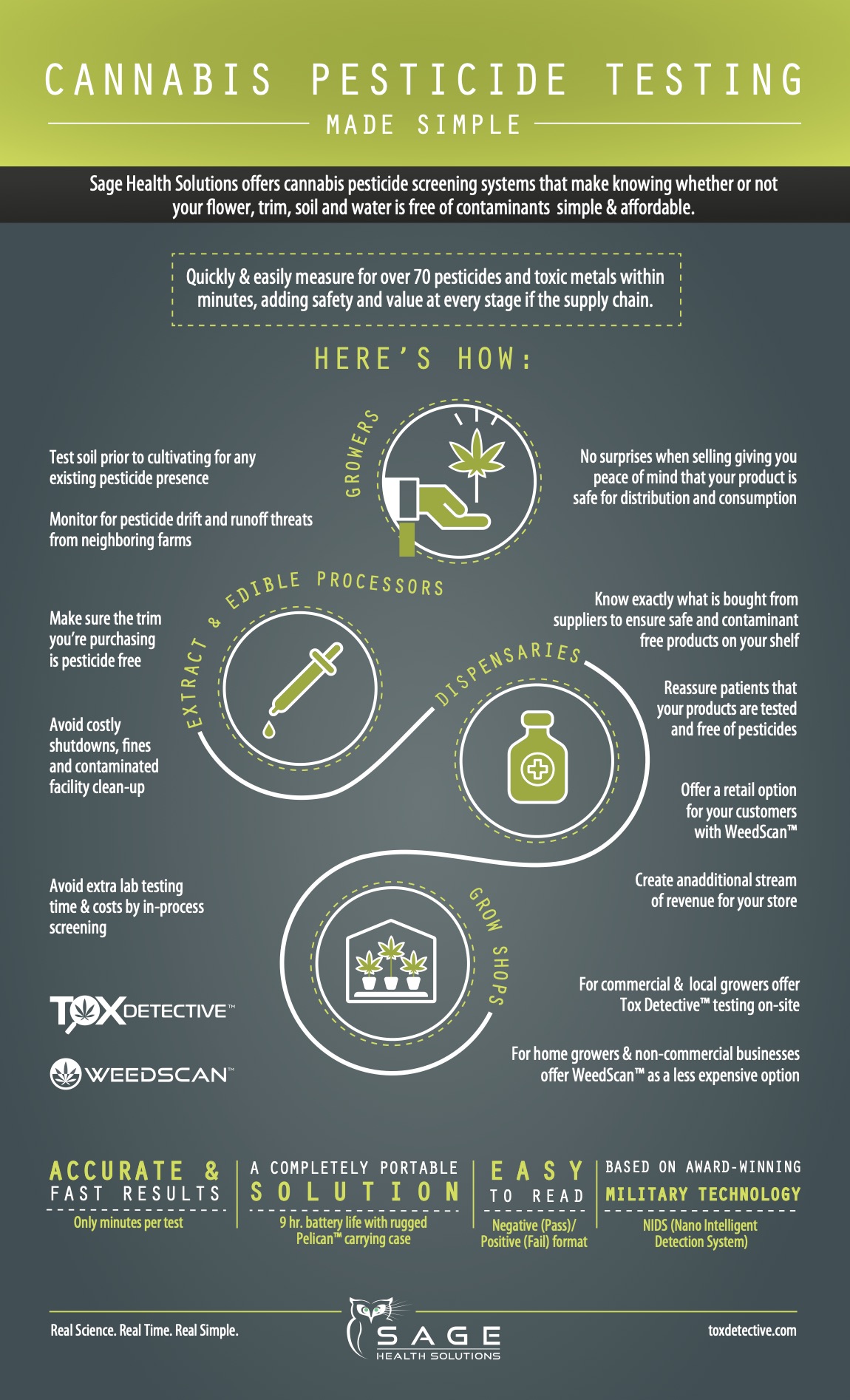
The technology inside Tox Detective wasn’t built for cannabis. It was built for soldiers’ drinking water — the NIDS ACE test came out of the US Army’s Environmental Sentinel Biomonitor program, which started with forty candidate technologies and finished with two. In places where a lab answer was ten to fourteen days away, it flagged pesticides in minutes, and it was chosen at Fort Detrick for its sensitivity, its reagent stability, and how little the person in the field had to do to run it.
Sage Analytics brought that lineage to the cannabis market: over 70 pesticides and toxic metals, minutes per test, a pass/fail readout, nine hours of battery in a Pelican case. The science was settled. The market was not.
Our half of the problem was the market-facing one — who buys this, what they’re actually afraid of, how they decide, and how the product should introduce itself. Sage had worked with us twice before; this was the third engagement, running across 2019 and 2020.
Six buyers, no shared motive
We built six proto-personas across the supply chain, and deliberately thin ones. A proto-persona is a page, not a report — a name, a quote, what they want, what they’re afraid of. Cheap to make, cheap to be wrong about, and easy to argue with in a room. In a market this young, being able to revise them mattered more than getting them right the first time.
What they showed was that Tox Detective had no single pitch. The small indoor grower is competing on quality and wants proof of it. The large outdoor grower is afraid of drift and runoff from land he doesn’t control. The concentrate producer wants to test before his customers do. The edibles producer is bracing for Constellation and Molson Coors to arrive with lab budgets. The dispensary owner wants a reason to be chosen over the shop down the street.
And the investor doesn’t want to test anything at all. He wants whatever the industry has already agreed is standard — which makes him the one persona who can say no on everyone else’s behalf, and the reason “the same technology the US government uses” had to sit at the front of the story rather than in the spec sheet.
J. Farmer
I take pride in my crops. I’d rather compete on quality.
- Wants
- Quality, safety, a reputation worth having
- Fears
- Remediation costs, large-scale growers
T. Corporation
Low quality concentrate production is the most profitable at scale.
- Wants
- Safe product, maximum yield value
- Fears
- Cross-contamination, soil pollution, remediation
F. Shady
If my customers might test the product I should get ahead of them.
- Wants
- Value, reputation, decarb optimization
- Fears
- Chemotyping, terpene and flavor control, trim consistency
M. Jane
I love baking and am excited to make a living at it.
- Wants
- Taste, safety, consistency, shelf life, a name
- Fears
- Bad concentrate, recalls, labeling, the big beverage brands
R. Smith
I’ve been a business owner before, but this is something I enjoy.
- Wants
- Higher price point, repeat customers, a destination
- Fears
- Legislation, competition, unlicensed sellers, sameness
J. Friend
I have disposable income and this seemed like a good investment.
- Wants
- Return, social access, industry standards he can point at
- Fears
- Legislation, competition, his own management team
Where the buying breaks down
We mapped six stages, from first research through reordering consumables, tracking what the buyer does, thinks, and feels at each one. The emotional line dips twice — once before anything is bought, once right after the first test — and those two dips are where most of the recommendations came from.
Before they know what to buy. The opening questions aren’t about Tox Detective at all — what guidelines do I have to meet, is there an industry standard, will I need a new device when the rules change. That’s someone shopping for a category, not a product. Educational material, third-party reviews and a visible client list do more work here than any feature claim.
The first time they run a test. Grind, bag, water, mix, pipette onto side A, control drops on side B, start the timer, insert the strip, read it. Every step comes with a silent am I doing this right — and a positive result immediately raises three more: how can I be sure, what caused it, what now. That moment is where the product earns trust or loses it, and it’s a support problem more than an interface one.
One number cut against instinct: industry research at the time put a B2B buyer’s trust in salespeople at around 18%. So the recommendation was to let people buy the device without talking to anyone, and to spend the sales effort on educating whoever did call — on the science, the legislation, and their specific use case — rather than on closing them.
The last stage is the business. Refill packs are the repeat purchase, which moves automatic reordering, loyalty pricing and fast shipping from a service afterthought to the revenue model. The map also surfaced a second product hiding in it: a prepaid return envelope for lab confirmation, sold to precisely the buyer who just got a positive result and wants to be certain.
Research & planning
“What guidelines do I need to meet? Is there an industry standard?”
Shopping
“Which vendor is the most established? Does the warranty vary?”
Purchasing
“Can I buy without talking to a salesperson?”
Unboxing
“Are the instructions easy to follow? Do I have the right samples?”
First test
“Am I doing all the steps correctly? How do I track results over time?”
Consumables
“Where do I get the best price on strips? How fast do they ship?”
What the search data actually said
Sage handed us a little over seventy keyword phrases to evaluate. We cut the ones that weren’t market-specific — fungicide testing says nothing about cannabis — and the ones written in a consumer’s voice rather than a business’s, like what’s in my weed. What survived, we measured against search volume, social discussion, and news trends.
It had almost no traffic. Not thin traffic — almost none. The overwhelming majority of search interest in cannabis testing is about potency, not toxicity, and what toxicity interest exists turns up alongside references to legislation and mandated requirements.
Based on these metrics, the cannabis industry has little demand for an in-house toxicity testing solution at this time.
— SEO & market report, June 2020That is not the finding anyone wants on a product that is already built, branded, and shipping. It was the finding, so it went at the top of the report rather than in an appendix. One term carried real traffic — cannabis pesticide testing — and it carried it because compliance made people go looking.
Take the demand that exists, then build more
First, stop losing the traffic you already have. The top result for “ToxDetective” belonged to TrimScene — a grow-equipment reseller that stocked the device, wrote the name as two words, and ranked ahead of the manufacturer for it. We pulled both sites apart and found nothing clever behind it: an older, larger site with more backlinks and no particular SEO effort. That was winnable.
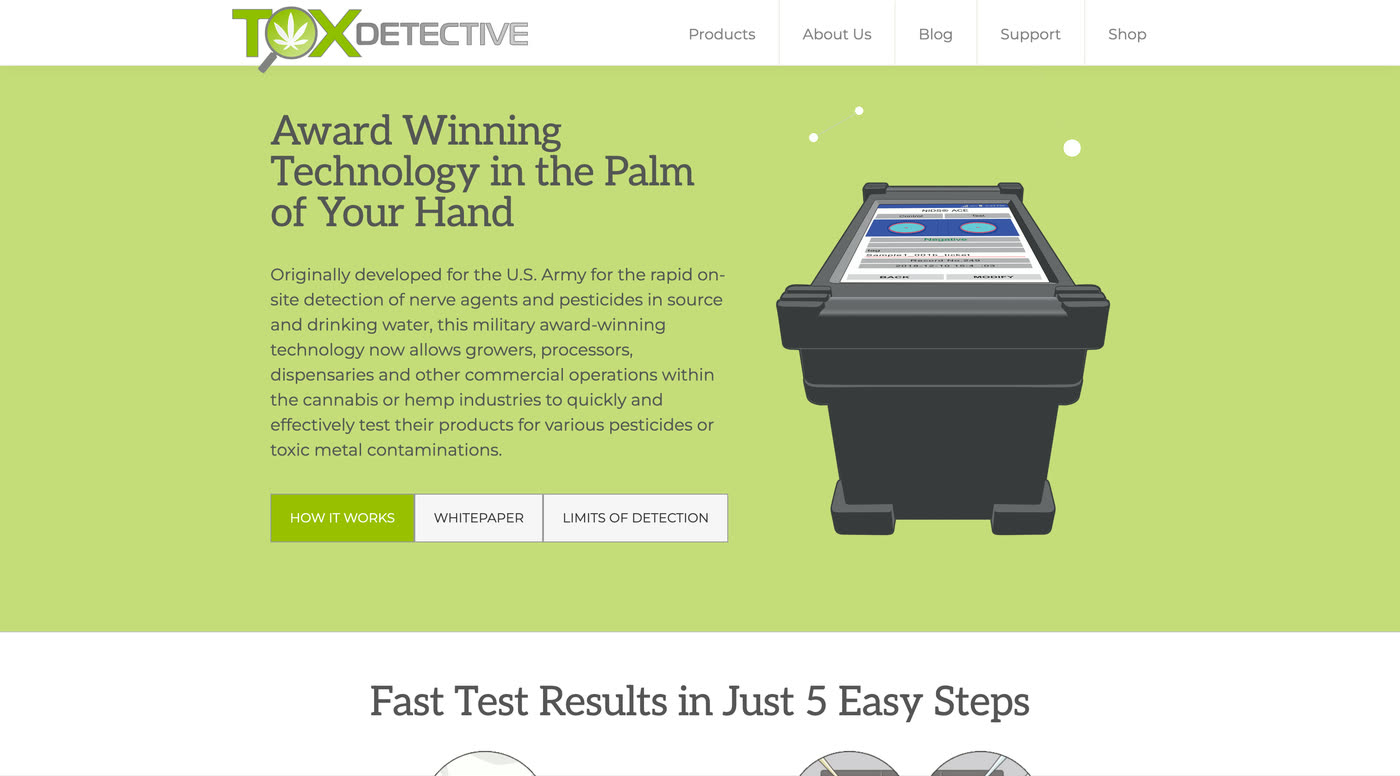
So we took it. Seventy-four content changes across nine pages of ToxDetective.com — titles, meta descriptions, headings, alt text, internal links — made lightly enough that the pages still read like they were written for people. Authoritative backlinks placed across Sage’s own domain, cache tuning for page speed, and a recommendation to turn the Limits of Detection PDF into a real landing page. By the end of the engagement, ToxDetective.com had passed TrimScene to become the top result for its own name.
Then, build the demand that isn’t there yet. The nearest analogue to toxicity testing is potency testing — which isn’t compliance-driven, and is wanted at every level of the industry. It got that way because consumers started asking what was in the product, and the pull travelled back up the supply chain.
Sage already owned the tool to run the same play: WeedScan, a consumer-priced version of the same test. A real consumer campaign for WeedScan puts a business owner in the position of watching customers test cannabis and talk about it — which is a different conversation than a cold pitch, and the one moment where a call to action for Tox Detective actually lands. The same spend works for both products.
How it ended
Case studies usually close with the win. This one doesn’t get to. Not long after the strategy was delivered, Sage’s owner stepped back from the business for personal reasons — and at almost the same time, the overseas factory building the device shut down. Retooling manufacturing elsewhere was more than a founder already stepping away wanted to take on, and the company was wound down before Tox Detective got a real run at the market.
We keep it in the portfolio anyway, because the work held. The market read was honest, the strategy took the inconvenient data seriously instead of writing around it, and the one track that shipped — the search work — won the ground it aimed at. Products die for reasons that have nothing to do with whether the thinking was right. This page is here for what it says about how we work when the data doesn’t say what anyone wanted.